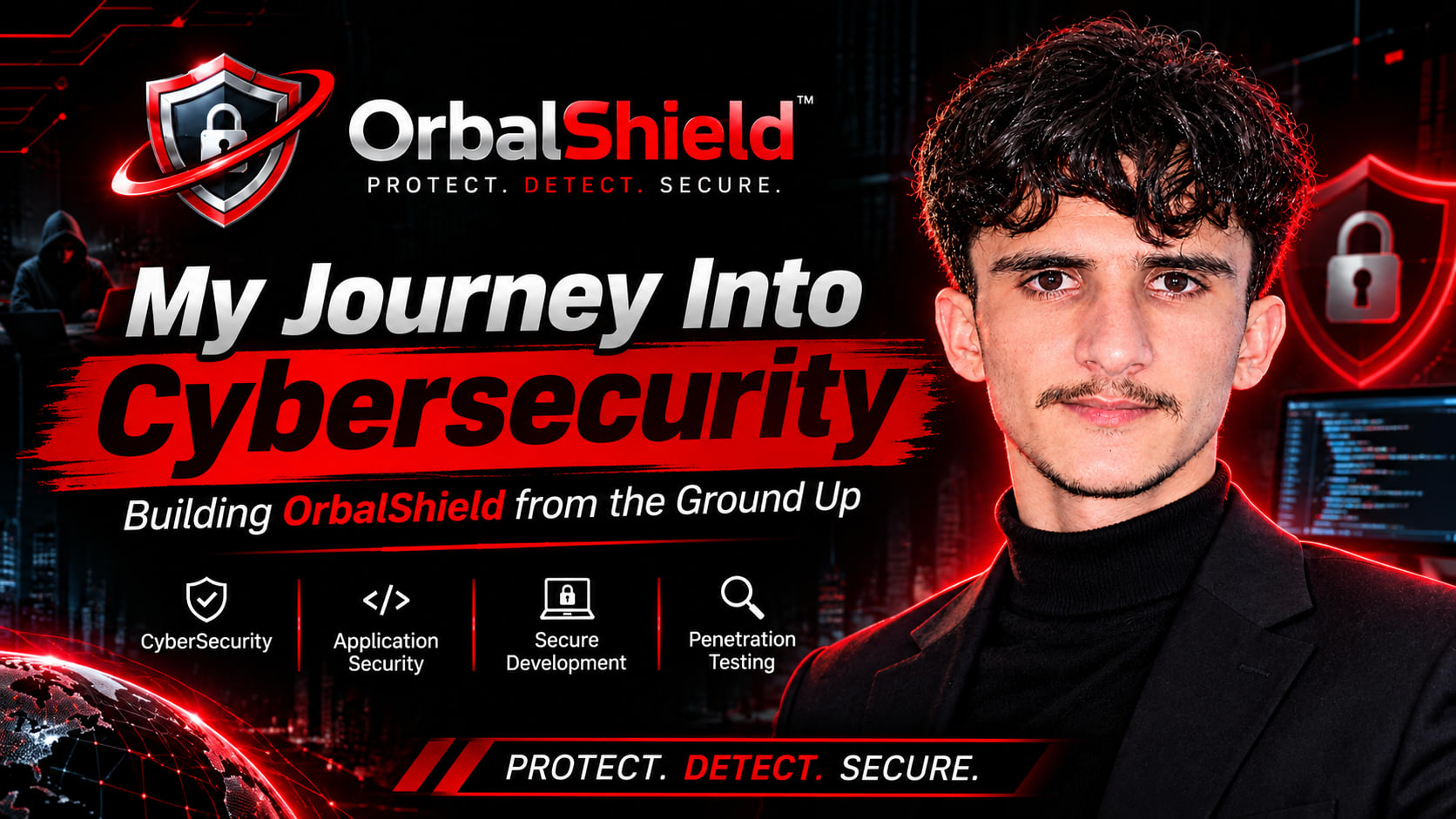
Building OrbalShield: Why I'm Taking Application Security Seriously
My journey from building software to helping make it safer --- and the
people I hope to build it with.
Software is being built faster than ever. AI-assisted development tools
can help developers turn ideas into working prototypes, generate
features, and move from concept to deployment in less time. That is
exciting, and I use modern tools as part of my own development workflow
too.
But faster development also raises an important question:
Are we giving software security the same attention that we give
software development?
An application can look polished, its features can work as expected, and
its APIs can return the right responses --- while weaknesses remain
hidden in its code, configuration, authentication flow, authorization
rules, or business logic.
That question is one of the reasons I started working towards
OrbalShield.
OrbalShield is an initiative I am building around application security
and secure software engineering. The work has started, but the company
is not yet fully active as a business. I am taking time to shape its
direction, build its presence, develop the right working process, and
connect with people who share the same interest in doing meaningful
technical work.
This article is a personal introduction to that journey: what I care
about, how I approach security testing, why I am building this
initiative, and the kind of people and projects I hope to bring
together.
From building applications to questioning how secure they are
My background is in software development, particularly backend
engineering. Working with application architecture, APIs,
authentication, authorization, databases, and application logic has
naturally made me curious about what can go wrong when these parts are
not designed or implemented carefully.
When I work with an application, I do not want to look only at whether a
feature works. I also want to understand how it behaves when someone
uses it in an unexpected way.
For example:
- Can a user access another user's information by changing an
identifier?
- Are authorization rules enforced on the server, or does the
application rely too much on the frontend?
- Can an API endpoint be abused by changing parameters, headers,
tokens, or request methods?
- Is input handled safely across different parts of the application?
- Are sensitive values exposed in responses, logs, configuration
files, or repositories?
- Does the application's business logic allow actions that should not
be possible?
These questions pushed me to look beyond feature development and spend
more time understanding application security.
I enjoy reviewing code, tracing how requests move through an
application, understanding the assumptions behind a feature, and
checking whether those assumptions can be bypassed. Security testing is
not just about running a scanner and reading its output. It requires
curiosity, patience, context, and the ability to validate what a finding
actually means.
My approach: understand first, automate second
I prefer a manual-first approach to application security testing.
That does not mean avoiding tools. Tools are valuable, and I use them to
improve coverage, discover issues, and validate findings. But I do not
want an automated scan to replace understanding the application.
My general workflow looks like this:
1. Understand the application
I begin by learning how the application is structured: its technologies,
user roles, important workflows, authentication mechanisms,
authorization rules, APIs, and data flows.
If source code is available and included in the agreed scope, I review
relevant areas to understand how the application is implemented.
2. Review code and business logic
I look for weaknesses in areas such as access control, input handling,
authentication, session or token management, data exposure, insecure
configuration, and business logic.
Some important issues are not obvious from a single request. They become
visible only after understanding how different features and permissions
interact.
3. Test requests and application behaviour
I use tools such as curl to inspect and send HTTP requests, compare
responses, test headers and parameters, and understand how endpoints
behave under different conditions.
Where appropriate, I write small scripts to repeat controlled test cases
and compare results. I also use manual test cases to investigate issues
that require application context.
4. Examine the exposed attack surface
Within an explicitly authorized scope, I may inspect relevant hosts,
services, ports, routes, and exposed endpoints. Tools such as Nmap and
ffuf can help with service discovery and content discovery.
The purpose is not to generate a large list of findings. It is to
understand what is exposed and determine whether anything creates a
meaningful security risk.
5. Validate with specialized tools
After developing an understanding of the application, I use tools such
as Burp Suite, OWASP ZAP, and source-code or dependency analysis tools
where they are appropriate.
I treat automated results as leads that need review. A scanner result is
not automatically a confirmed vulnerability. Findings should be
reproduced safely, checked for false positives, and assessed in the
context of the application.
6. Explain the issue and help improve it
A useful security assessment should do more than identify a problem. It
should explain:
- What the weakness is.
- Where it exists.
- What impact it could have.
- What evidence supports the finding.
- How it can be fixed.
- How the fix can be retested.
The goal is to help improve the application, not simply produce a report
full of technical terms.
All testing must be performed with the owner's explicit permission and
within an agreed scope. Production systems, user data, and business
operations must be treated carefully.
Why OrbalShield?
I have seen how quickly software development is changing. AI-assisted
coding can make it easier to create applications, but generated code
still needs engineering judgment, review, testing, and maintenance.
AI does not automatically understand every business requirement,
deployment environment, permission boundary, or security assumption. The
same is true of code written entirely by humans: it can contain mistakes
too.
I do not see AI as the problem. I see it as another reason to take
secure development and independent security review seriously.
A working application is not necessarily a secure application.
I want OrbalShield to focus on that gap: helping people understand the
security of the software they build, identify weaknesses in existing
applications, and improve systems through practical engineering.
The direction I am working towards includes:
- Web Application Security Testing --- examining web applications
for security weaknesses.
- API Security Assessment --- reviewing API authentication,
authorization, input handling, and data exposure.
- Secure Code Review --- examining source code for insecure
patterns and implementation flaws.
- Vulnerability Assessment --- identifying, validating, and
prioritizing security issues.
- Security Remediation --- helping developers understand and fix
confirmed weaknesses.
- Secure Software Development --- building applications with
security considered from the design stage.
These are the areas I am developing OrbalShield around. I intend to take
on work responsibly, based on the project's scope and the capabilities
available at the time.
Building with people, not just building a brand
There is another important part of this journey.
I am connecting with people who have useful technical skills, an
interest in security or software engineering, and the motivation to
build something of their own. Some are independent, some are exploring
their next opportunity, and some may already be working while thinking
about creating something beyond a traditional job.
I believe there are capable people who have the skills and willingness
to contribute but do not always have the right opportunity, team, or
project around them.
I would like OrbalShield to become a place where people like this can
connect, exchange knowledge, work on practical projects, and gradually
build a professional team.
I am not presenting this as an established team or promising jobs that
do not yet exist. This is an early-stage effort. I want to build
relationships honestly, understand people's strengths, agree on
responsibilities, and create opportunities through real work.
If we collaborate on a project, expectations, ownership, compensation or
voluntary contribution, timelines, and responsibilities should be
discussed clearly before work begins. Respect for people's time and
skills matters.
My aim is to build something sustainable with people who care about the
quality of their work --- not simply collect names or create a team
page.
What I am working on right now
At this stage, I am working on the foundations:
- Establishing OrbalShield's identity and online presence.
- Developing a company website and explaining its services clearly.
- Improving my own application security testing methodology.
- Building connections with security researchers and software
developers.
- Defining a responsible client assessment and reporting process.
- Exploring practical ways to combine security testing with secure
software development.
The public launch will come after these foundations are stronger. I
would rather build a credible service step by step than announce
capabilities before I can consistently deliver them.
Who I would like to connect with
I am interested in connecting with:
- Application security researchers and ethical security testers.
- Backend and full-stack developers who care about secure engineering.
- People interested in API security, code review, and vulnerability
research.
- Independent developers and technical professionals who want to
collaborate on practical projects.
- Businesses and founders who want to understand the security of an
application they own or are authorized to have assessed.
If you are building a web application, developing an API, reviewing an
existing system, or planning a new secure product, I am open to
discussing the technical requirements and seeing whether I can help.
For security testing, authorization and a clearly agreed scope are
essential. I will not test systems without permission.
An invitation
I am sharing this journey publicly because I want to be intentional
about what I build next.
I am not claiming that OrbalShield is already a large cybersecurity
firm, nor that every service is fully operational today. It is an
initiative in its early stages, and I am working to turn it into a
professional application security and software engineering business.
If you are a developer, researcher, founder, or someone who believes
security should be part of the software development process, I would be
glad to connect.
If you have an application that needs a security review, a feature that
needs to be made safer, or a new system that should be designed with
security in mind, feel free to reach out. We can discuss the scope,
expectations, and a practical way forward.
The journey is just beginning. I want to build it with care, technical
honesty, and people who take their work seriously.
OrbalShield
Protect. Detect. Secure.
Building safer digital experiences --- one application at a time.
Connect with me on LinkedIn
Comments 0
Guest comments are reviewed before they appear.
Loading comments…